“No great art came from a happy life.” I’ve been listening to many interviews of well-known creative people, conducted by John Wilson on BBC Radio Four’s This Cultural Life, and this theme echoes through many of them. Writers, actors, composers, musicians, choreographers, artists – listening to the stories of their lives and what has influenced them is a balm for the haggard writer in me.
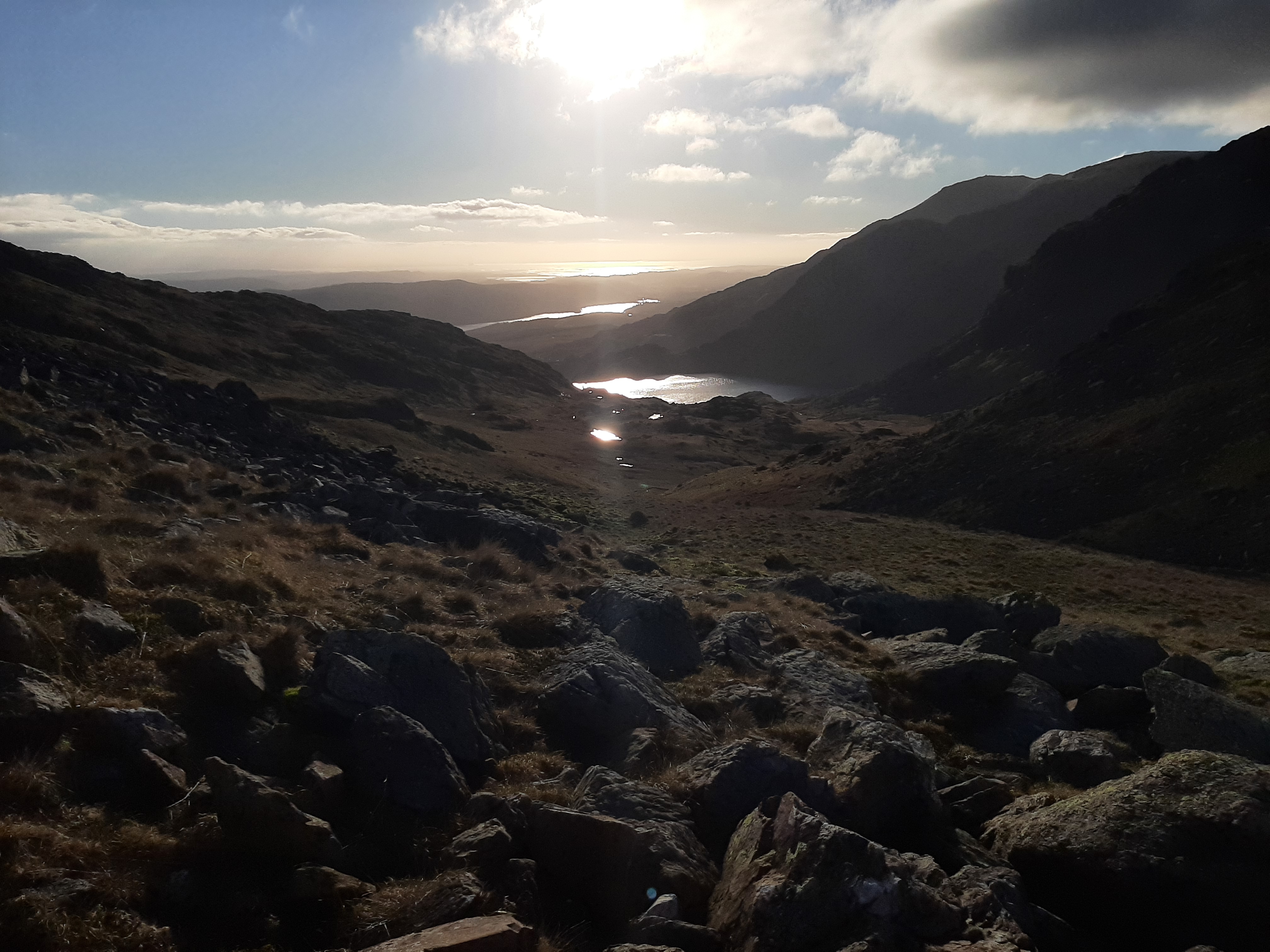
Looking south from Swirl Hawse towards Morecambe Bay in the distance
The most captivating characters in stories are those embroiled in extreme circumstances who, with vital help from an “enemy” or someone unexpected, break free into a new level of awareness of who they really are and what they are capable of. This timeless story awes our inner orphan who stashes away the inspiration for an auspicious moment that perhaps lies decades in the future.
It’s daytime of Christmas Eve and the weather is stunning – crisp, clear and nostalgic. Crystalline water cascades and pools on its way down from the craggy shoulders of Coniston Old Man, my go-to mountain in England’s Lake District, just half an hour’s drive away. Part of me wants to stop and gaze into these mesmerising pools, but I push on in order to reach the tarn (mountain lake) just beneath the summit and put up the tent before dusk creeps in. The path snakes up past old slate and copper mines last operated in 1950. Dying-back bracken is goldened by the sun.
“Bach’s life was drenched in grief,” remarked the pianist James Rhodes. “Bach was bullied at school, half his kids died young, his wife died young . . .” War raged in Europe more often than not. And look at what Bach, and other composers and artists of that time, created. Great art is a journey into suffering, into loss, in order to make some sense of it; a search for meaning – something more useful than a blind pursuit of Hollywood-styled “happiness”, because from meaning blooms peace. From understanding blooms compassion. Creating beauty creates joy.
No one else has thought to camp out at the tarn, so all three possible spots to pitch a tent are available. A raven honks overhead. It takes a while to put up the tent, fully pegged down, because there’s lots of rock just beneath the grass. Take out stove. Boil water. Warm my hands around a heavenly cup of Horlicks, and I’m reminded of all the times I’ve warmed my cold motorcyclist-hands around a cup of tea beside mountain roads in far flung places, served by someone smiley. I warm my hands some more while holding the hot bag of rehydrating food.
As I eat a surprisingly tasty stew, a bold mouse stops for an unusually long moment in the beam of my head torch. I’ve never noticed a mouse in these mountains before. It’s just a metre or so in front of me. Bulbous shiny dark eyes. Rounded ears. Other than searching for food, I wonder if its appearance is trying to tell me something, this industrious being who stays close to the ground, at home in the dark, stepping casually into the limelight, alert but seemingly relaxed about being seen.
“Confidence comes from putting yourself out there,” says Greg Scheinman, a midlife coach whose words arrived in a recent email from Chip Conley, founder of Modern Elders Academy in the US. “From wanting to do something and then going out and doing it . . . It builds.” This resonates strongly. Since spring last year, one evening a week, I’ve been volunteering at an organisation in Barrow-in-Furness, helping a small group of teen boys navigate life. The mentee calls out the mentor, said the storyteller Michael Meade, and he’s right. Those boys help me as much as I hopefully help them.
It’s 6:00 PM and too cold to sit out and gaze at stars. The wind is picking up, as forecast. If it were summer I’d have swum in the tarn by now. So I get into the tent and the sleeping bag. I make an attempt at meditating but it doesn’t last long. I say my usual prayer. I lie down. I’m not tired. Only fourteen hours until dawn. It’s going to be a L-O-N-G night. The last time I was in a tent for this long was in 1997, camping in the snow above Lhasa. I shared a tent with a friend. He snored the enitre night, from dusk until dawn. At least this night won’t be as long as that one.
While wrapped up the sleeping bag, I go over my own journey of trying to stay true to my art, my vision. This is a daily thing, reminding myself to be patient, to trust in the timing of things, that the world’s boat needs to be rocked a bit, and probably quite a bit more, until we finally wake up to the extraordinary journey we’re all on and act accordingly. A fine line. I say to myself that all the unpublished writing projects, and so many notes, are stepping stones to the seventh book I’m currently working on and plan to publish this year, itself a stepping stone to whatever awaits in the next chapter of life. As usual my doubts are fleeting. The timing of this latest book feels right.
And anyway, what matters most is the art, the poetry, we make of our lives, primarily beheld and valued by an audience that’s other-than-human. Is that not why we’re really here – to create beauty from the unavoidable loss that comes from being human? The simple beauty of being more present for people because we increasingly realise how precious life is. Beauty ignites us, delights us, because it’s our deepest nature, each of us distinct but inseparable from an ever-evolving, ever-curious intelligence. I have no doubt about this because in rare moments when I’m sufficiently still I sense it in a way that’s awesome and undeniable. When have you sensed it? It stands to reason that everyone can.
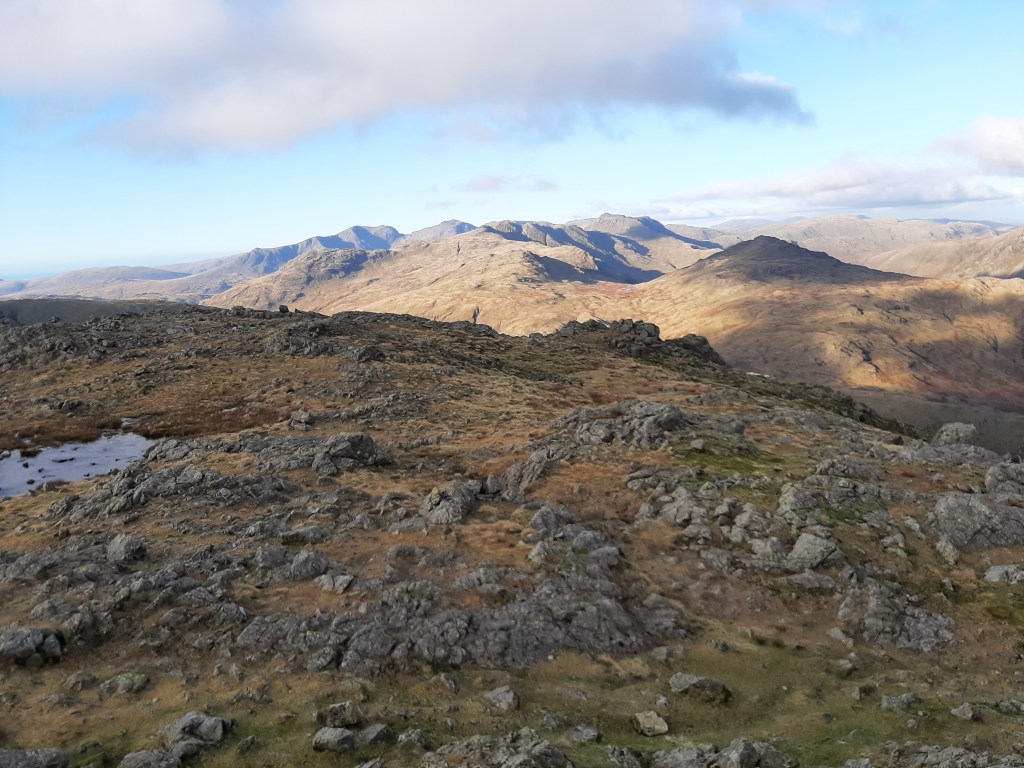
The Scafell range of mountains from Wetherlam
I think of all the suffering in the world today and I wonder, if we accepted its invite to step up a little more, what great art we might transform it into – billions of small-seeming acts of kindness, the chain-reactions they set in motion, creating a masterpiece unlike any that has gone before it.
When my mind becomes still, the wind calms. When my mind becomes busy again, fierce gusts shake the tent. This will be a theme throughout the night. As will needing a pee, goddammit. Out into the chilly night. Boulders shadowy like resting rhinos. A quick hello to the stars and back into the tent.
I toss and turn to get comfortable. Pulled muscle in left shoulder still not fully healed. I barely sleep so I barely voyage into the Underworld we call dreaming. The first time I camped here, a middle-aged man dressed in a tweed jacket and a flatcap had stepped, completely dry, from the depths of the tarn and strolled towards my tent. I awoke in shock then wished I hadn’t. He’d looked calm and friendly. What might he have told me? To relax, probably. Fully relax. And trust. The usual message. This time I catch only glimpses as I doze: the silhouette of a falcon in flight; a single flash of lightning forking from the heavens to earth, and I think of Zeus; a humble-looking shrine in a cave, otherworldly-vivid, inviting me to enter though I can get no closer to it before the image fades.
I remember a recent dream of a fully-grown, male, black bear in a hotel lobby. Following years of fleeing bears in the Underworld, attacking them, and once stealing their cubs, this one I calmly approached. It glanced at my bottle of water. It was thirsty. I emptied the water into the bear’s gaping jaws. A moment later the bear tucked into a great plate of food and water that had appeared. Finally we had bonded. A bond that’s easily rebroken if not enacted on a daily basis.
In his novel Iron John, Robert Bly said that modern men (and women also) are generally terrified of the wild and hairy masculine energy that lies dormant in the depths of their psyche. To wake it and feed it with our attention is to become accountable to it. That bear is actually a king, a deeply intelligent and compassionate king, who knows how to create unity in a troubled world, and co-create solutions that work for the whole. Compassion aligned with systems thinking. He’s inextricably bound to an inner queen and her intuition.
Robert Bly also remarked that modern culture, and its insatiable and insane economy, has channelled our yearning for mystery and meaning almost entirely into sexuality and an obsession with staying young. Such a re-routing logically leads to depression which, if you’re lucky to have guidance, is a pathway back to feeling and deeper sensing, having learned something vital along the way. Yearning for mystery is untangled from desire. Need is untangled from want.
This long restless night in a cocoon-like tent feels suitably symbolic, like a contraction of a whole life up until now. And this coming dawn, this coming year feels immense; above all, an immense opportunity for all of us to emerge from our cocoons and to show the world what it means to be fully human, each day a little more so. “We are always on the edge of the unconscious,” said the philosopher and mystic Henry Corbin. We are all explorers and it’s done through imagining and caring.
At eight thirty I open my eyes to a bright tent. Thank God. Sunrise turns the mountain gold. By the time I’ve had breakfast and packed away the tent, my toes are numb. I’m grateful for the final climb to the summit to walk some feeling back into them. And when I get there . . . oh, the view . . . Crystal clear winter sky. The vast expanse of Morecambe Bay to the south, shimmering gold, an ever-changing sight I never tire of. Summits – old friends – in every other direction. I set off northwards along the ridge towards Swirl Howe and Wetherlam mountain beyond. The wind, a beast from the East, gusting up to 40 mph, makes it hard work, which also feels symbolic: without something to push against where’s the growth? Where’s the story?
What will I do my best to leave behind in 2025? Over-thinking. Of course it will follow me, because over-thinking is what brains do, but with practice, and that all-important pause, I’ll encourage it to ask questions to our friend the bear and let it decide what we might do in each situation. How about you – what no longer serves you that can be left behind? If you listen with your ancient bear-ears, what’s calling out to you?
Below is a short poem by Juan Ramón Jiménez that sums up existence so eloquently. Also attached is a short video of the view from the summit of Coniston Old Man.
I Am Not I
I am not I.
I am this one
Walking beside me whom I do not see,
Whom at times I manage to visit,
And at other times I forget.
The one who remains silent when I talk,
The one who forgives, sweet, when I hate,
The one who takes a walk when I am indoors,
The one who will remain standing when I die.
Juan Ramón Jiménez


 SlowJinn